It is a conversation I have often. Someone calls me with two quotes for a home inspection of the same flat and asks why one costs almost twice as much as the other. Before talking about price, I ask one question: do you know who will come to the visit and who will sign the report? They almost never know. And that is what matters most, because in Spain no law says who can carry out a home inspection before you buy. That is why at Revicasa we decided from the start that only a registered architect would do it.
Who can carry out a home inspection
The short answer is: anyone. A pre-purchase inspection is a private service between you and the person who does it. It is not like the ITE, the building inspection that the city council requires and that a qualified technician must sign. To inspect a flat before buying it, no degree, no training and no insurance are required.
This means that very different things are sold under the same name. It can be a person who walks through the home with a checklist and writes down what they see. Or it can be a professional who understands why each defect appears, what it means and what to do about it. Both are called the same thing in an advert, but the report you get is completely different. And at Revicasa we wanted to take that difference further: our report is not like the report of any other company that offers this service. I explain why below.
What it means that an architect is registered
To work as an architect in Spain you must be registered with a professional association (colegio de arquitectos). It looks like a formality, but it has very concrete consequences for the client:
- The degree is checked. The association checks the official qualification before registering an architect.
- There is a code of conduct. The architect must follow professional rules and can be disciplined. If they act badly, you can complain to their association, not only to the company.
- You can check it yourself. The Spanish Professional Associations Act requires each association to keep a public register with the name, registration number and qualification of each member.
- Someone is responsible for what is signed. The report carries the name of an identifiable professional who is responsible for their work.
For me, the last point is the most important. Signing with your name and registration number makes you write carefully. Note: a home inspection report is not written for a lawyer or a judge; that is an expert report. It is written for you, because you have to decide whether to buy. That is why I do not write “there seems to be damp”: I write where I think it comes from, how serious it is, what signs make me think so and what test would confirm it. With that, you can decide, negotiate or ask for a quote.
Why an architect for a pre-purchase inspection
Architecture studies cover structures, construction, building services and technical regulations. That is exactly what you need to look at in a home before you buy it. But what an architect brings is not the list of things they check. It is the judgement to understand what they see.
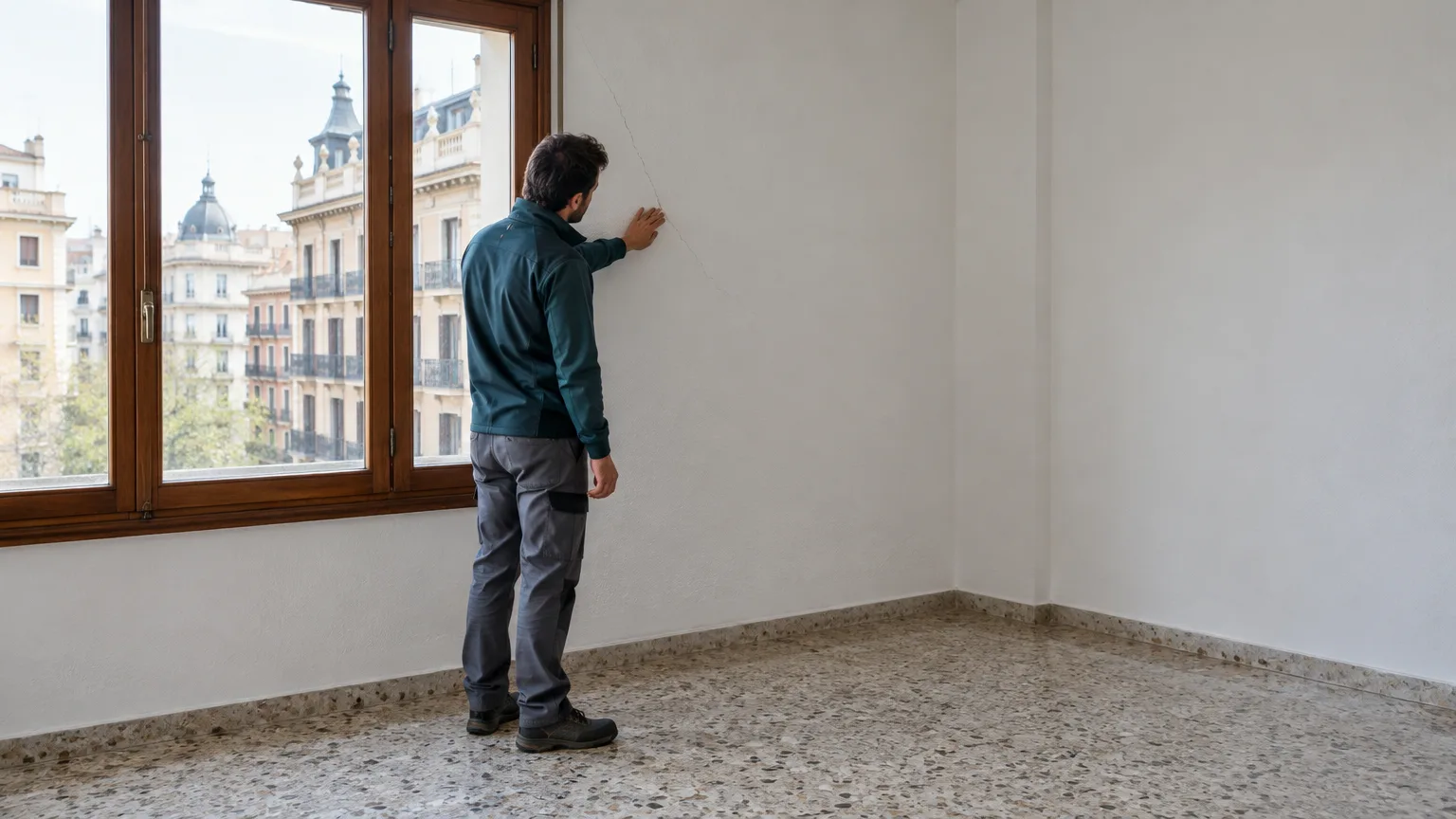
Here is an example I see often. In a flat from the sixties I find a crack at the corner of a window. It can be a surface crack in the plaster, caused by shrinkage, with no real importance. Or it can be a sign that the lintel or the facade is moving. What tells them apart is the shape, the width, whether it repeats on other floors and how the building is built. I explain this in more detail in cracks and fissures in walls: how to tell them apart. Writing “there is a crack” does not help you decide. Knowing which of the two it is does.
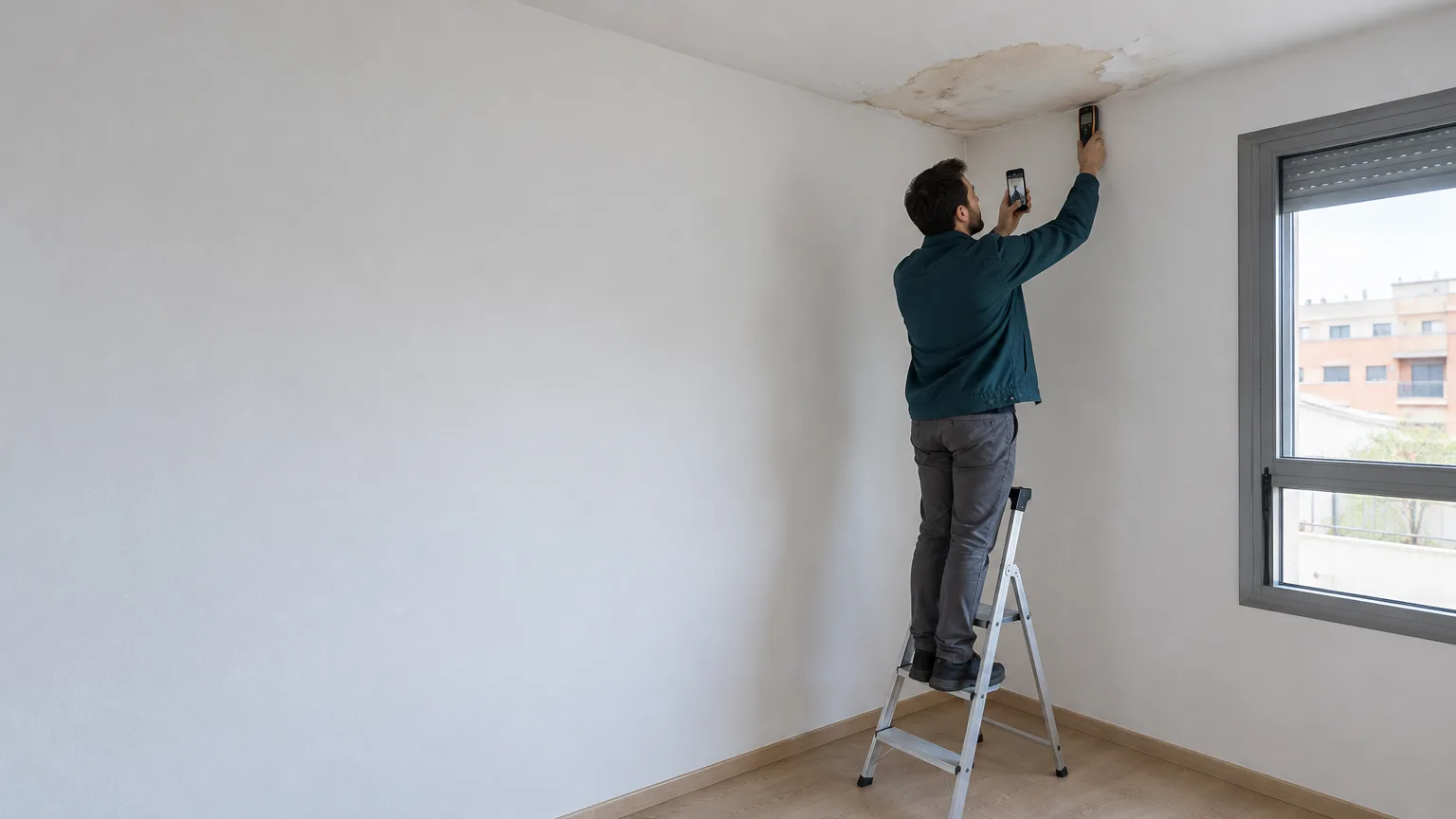
The same happens with damp. A stain at the bottom of a wall can be condensation, water ingress or rising damp. Each one has a different cause, cost and person responsible. And then there is the part buyers value most: putting things in order. A report with forty defects and no priorities is scary and useless. A report that separates minor, moderate and serious defects tells you where to look first and what to use in a negotiation.
| Aspect | Checklist review | Inspection by a registered architect |
|---|---|---|
| What it does | Writes down what it sees | Explains why it happens and what it means |
| With a crack | “There is a crack” | Whether it is a surface crack or could be structural, and what test is needed |
| With damp | “There is a stain” | Its likely cause and the signs that support it |
| Priorities | A list of defects | Defects classified by severity and urgency |
| Who is responsible | Not always clear | An architect with a name and a registration number |
How we work at Revicasa
All our inspections are carried out by a registered architect from our network who works near the property. But being a registered architect is the starting point, not the end. At Revicasa, a degree is not enough to inspect in our name.
We train and approve each architect
- We check. We verify the degree and registration of each architect before they join the network.
- We train. Each one receives specific training in our inspection method: what to check, how to measure, how to classify the severity of each defect and how to explain it.
- We approve. Only when they have completed this process do we approve them to carry out Revicasa inspections.
It is a process I have not seen in any other company in the sector, and it is what allows the report to have the same level in Madrid as in any other province, whoever the architect is.
A report unlike any other
During the visit we check the visible structure, the facades and the roof where accessible, the windows and doors, the electrical installation, the plumbing, the heating and air conditioning, and damp, with a thermal camera and a moisture meter. You receive the report in 48 hours, with photos, the severity of each defect and clear recommendations. You can see what it looks like on our pre-purchase inspection page.
The report is not a list of photos. All our architects work with the same app and the same method, so each defect comes with its location, its severity, its likely cause and what I recommend you do. It is designed so that you can understand it without being an expert, and so that you can use it: to negotiate with the seller, to plan a renovation or to ask a builder for a quote. I explain how to read it in what the inspection report contains and how to use it.
The price is fixed and depends on the floor area: flats start at €299 and houses at €369. You can see everything on our prices page.
My advice: before you book an inspection, ask for the name and registration number of the person who will visit, and look them up in their association’s register. It takes two minutes. Also ask who signs the report and whether they have professional liability insurance. If they cannot answer, you already have your answer.
When to book the inspection
The best time is before you sign the deposit contract (arras). With the report in your hand you can still negotiate the price, ask for repairs before the deed is signed, or decide not to go ahead. If you have already signed the deposit contract, pulling out can cost you the deposit, unless the contract includes the inspection as a condition. That is why it is best to book it before, or to write it into the contract.
For a new-build home the moment is different: just after you get the keys, with electricity and water connected, so that all the installations can be tested. That is when you should put in writing everything that is not well finished, so that the developer can repair it. I explain this in our guide to new-build inspections.
If you have already bought and damage has appeared, what you need is not an inspection but an expert report. I explain the difference in expert report or home inspection: which one do you need?.
What a visual inspection cannot see
Being an architect does not give me X-ray vision. In a visual inspection I do not open walls or lift floors, so I cannot see the condition of a pipe inside a wall, the steel inside a beam or the foundations. I also cannot check what is hidden by furniture or what is not accessible, such as a roof without safe access. And an inspection does not replace a certificate from an authorised installer: if the electrical or gas installation needs a certificate, the installer must issue it.
What does change with an architect is what I do with those limits. When a sign points to something I cannot see, I say so in the report and explain what test would be needed to confirm it: a small opening in a wall or floor, an endoscope or a check by an installer. I prefer to tell you what I do not know rather than give you a peace of mind I cannot guarantee.

Written by
Iván Samaniego
Registered architect (COAM) and co-founder of Revicasa
On the blog he shares what we learn on every inspection so you can decide with objective information.