Most of the time, the people who call me looking for a building expert are not quite sure what they are asking for. They know there is a problem in their home and that someone has to say, with authority, who is responsible. Recently a couple wrote to me after a year of arguing with the developer about a terrace that was leaking water into their bedroom. They had photos, emails and a repair quote. What they did not have was a technical document explaining why it leaked and who had to fix it. That is exactly what a building expert does. Here I explain what my work involves when I act as an expert, which qualification is required, and when it is worth calling one.
What a building expert is and which qualification they need
A building expert (in Spain, a «perito de construcción») is a professional with building knowledge who issues an opinion on a specific fact: damage, a construction defect, or work that does not match what was agreed. It is not a profession in itself. It is a role carried out by someone who is already an architect, a technical architect (building engineer) or a building engineering graduate. You will also see terms such as «housing expert», «building surveyor» or «damage expert»: in practice they mean the same thing.
In court proceedings, Spain's Civil Procedure Act requires the expert to hold the official qualification that matches the subject of the report. If the subject is a building, its structure, its installations or its construction, that qualification is architect or technical architect. So when someone offers you an expert report, the first thing to ask is what their qualification is and whether they are registered with their professional association: the association checks the degree and keeps a public register where you can look them up.
In my case, I am an architect. What this training brings to an expert report is the ability to read a whole building: how its structure works, where its installations run, how it behaves against water and how it was built at the time. Damage is rarely where you see it. A stain on a ceiling can start three metres away, at a terrace joint or in a hidden downpipe, and finding it requires understanding the building, not only looking at the stain.
What a building expert does
My work as an expert is very different from a home inspection. In an inspection I go through the whole property and record everything I find so that a buyer can decide. In an expert report I focus on one problem and stay with it until I know where it comes from. I explain the difference in detail in expert report or home inspection: which one do you need?. In short, the process is this:
- I study the documents. Title deeds, project, specification of finishes, building contract, insurance claims, communications with the other party. Sometimes the cause is already in the paperwork: an item that was never built or a project change that was not documented.
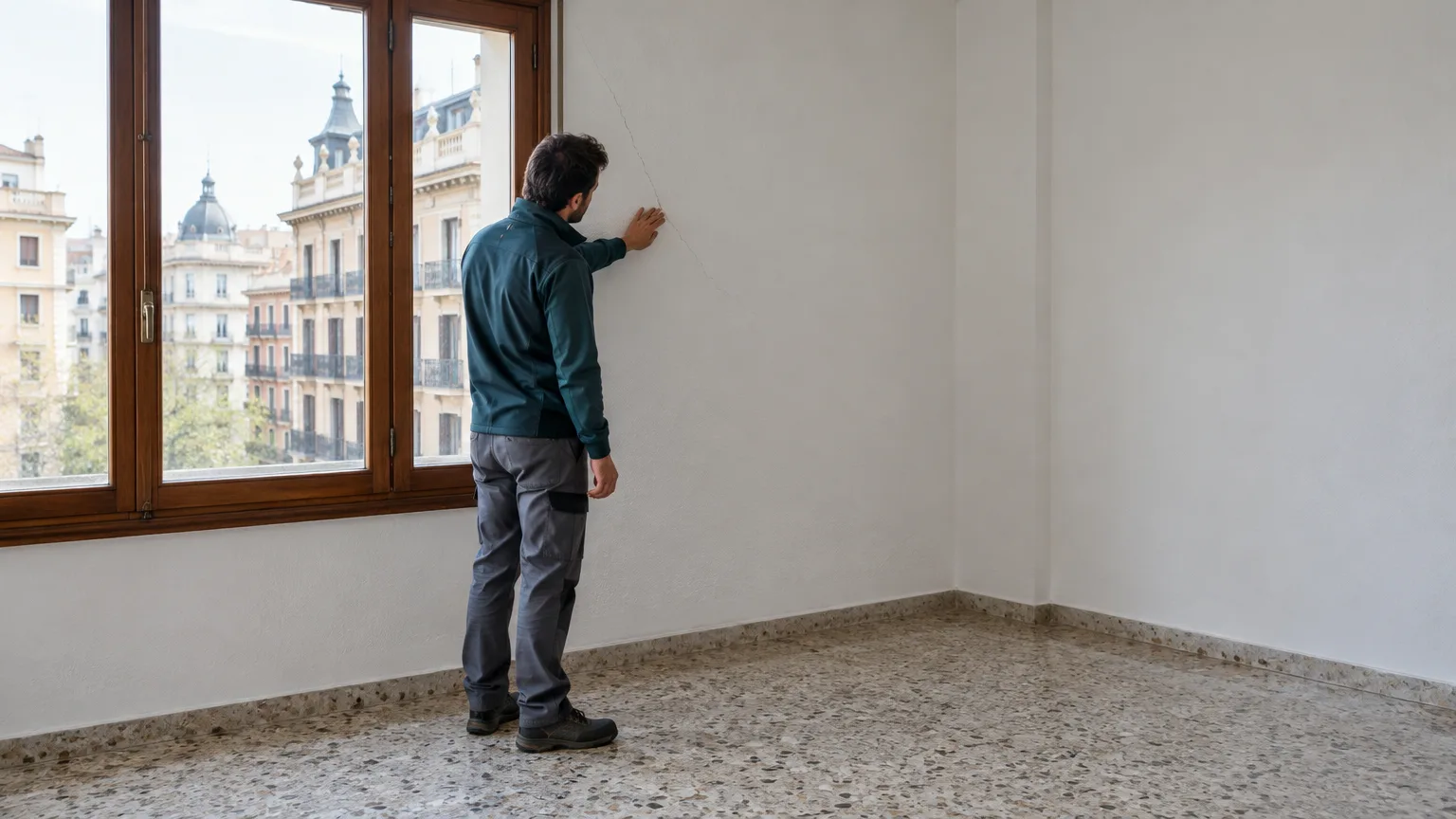
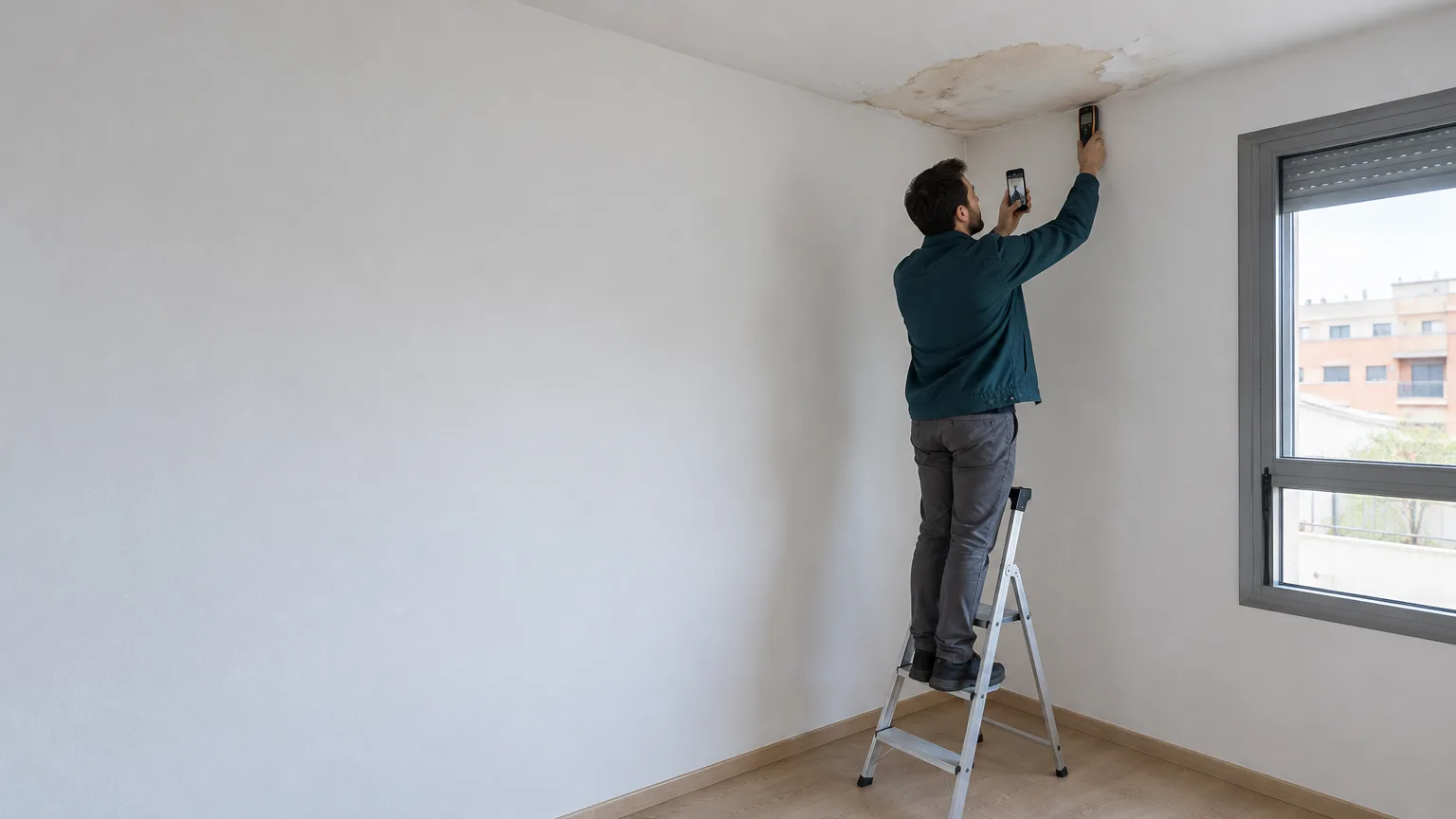
- I visit and measure. I record the damage with dated photos, measurements and, when needed, a thermal camera and a moisture meter. If the cause may be in another home or a common area, I ask for access.
- I make hypotheses and rule them out. Damp at the base of a wall can be condensation, leakage or rising damp. Each cause has a different party responsible, so it is not enough to say there is damp: I have to prove which one it is.
- I establish the cause and the technical responsibility. Which element or which party is at the origin of the damage, according to the regulations in force when it was built or renovated.
- I value the repair. Item by item, with measurements and market prices, so that the figure can be discussed with data and not with quotes from one side.
- I write the expert report and, if the case goes to court, I confirm it and defend it at the hearing.
The whole report is written for someone who has never been in the home and who may have reasons not to believe it. That is why every conclusion is backed by a photo, a measurement or a document, not by my opinion. You can see what it includes and how to order it on the expert report page.
When to call a building expert
The signal is always the same: there is damage or a defect and someone has to answer for it. These are the situations I see most often:
- Leaks from another home. The neighbour upstairs, or the community of owners, does not accept that the cause is their terrace, their bathroom or a shared downpipe.
- Defects in a new-build home that the developer does not repair or blames on misuse. Spain's Building Act (LOE) sets guarantee periods of one, three and ten years depending on the type of defect, and an expert report is the way to prove the defect within those periods.
- A badly executed renovation. The contractor was paid, the work is not right, and there is no agreement on what is wrong or how much it costs to fix.
- A hidden defect after buying. A serious problem appears that was not visible when you bought, and you want to claim against the seller. I explain this in I found a hidden defect after buying: what can I do?.
- An insurer rejects the claim or values it far below the real cost of the repair.
- Damage from building work next door or in a neighbour's flat: new cracks, partition walls that move, doors that no longer close.
- A dispute in the community of owners about whether damage affects a private element or a common one.
It is also useful to know when you do not need one. If you have not bought yet and want to know the condition of the property, what you need is an inspection, which is faster and cheaper. If you have just received the keys to a new-build home, the first step is a new-build inspection that records the defects; the expert report comes only if the developer does not respond.
Party-appointed expert, court-appointed expert and insurance expert
| Type of expert | Who appoints them | What it is for |
|---|---|---|
| Party-appointed expert | You, your lawyer or your community of owners | To record the damage, negotiate and, if needed, submit it as evidence in a claim |
| Court-appointed expert | The court, at the request of one of the parties | An impartial opinion when the judge needs technical criteria independent of the parties |
| Insurance expert | The insurance company | To value the claim according to the terms of the policy |
In most cases I act as a party-appointed expert. That does not mean I write what my client wants to read. The report is the basis for a negotiation or a trial, and a report that exaggerates or hides what is inconvenient falls apart as soon as the other side's expert reads it. If the result does not favour the person who hired me, I tell them before I sign.
Architect as court expert: what happens after signing the report
An expert report does not end when I deliver it. If the dispute reaches the courts, the architect acting as expert, whether appointed by a party or by the court, must meet three obligations set by the Civil Procedure Act:
- Swear or promise objectivity. The report includes a statement that I act with the greatest possible objectivity, taking into account both what favours and what harms any of the parties.
- Accept challenges. The other party can argue that I have an interest in the case, a family link or a relationship with one of the parties. That is why I do not accept cases where I have already acted as designer or site director.
- Confirm the report and answer at the hearing. The judge and the lawyers of both parties can ask me about any point in the report. A well-made report defends itself; one made in a hurry shows at that moment.
When the court appoints the expert, the party that requested it pays the fees in advance as a deposit, and the judge may later include them in the legal costs. When the expert is party-appointed, you pay and your lawyer decides when to submit the report.
My advice: as soon as the damage appears, do three things before calling anyone. Photograph it with the date, report it in writing to whoever you think is responsible (neighbour, developer, contractor or insurer), and do not repair or cover it until an expert has recorded it. What is repaired before the visit can only be reconstructed from photos and statements, and that weakens any claim.
How much an expert report costs and how long it takes
An expert report does not have a fixed price like an inspection, because every case is different: a localised leak is not the same as a badly executed full renovation or structural damage to a building. At Revicasa the expert report starts at €1,200 and the quote depends on the complexity of the case. The usual time is one to three weeks from the visit, longer if additional tests are needed. Keep in mind the deadlines for your claim: for hidden defects against the seller there are only six months from handover, so it is best to order the report early.
What a visual inspection cannot see
An expert cannot see through walls either. During the visit I can check what is accessible and measure what the thermal camera and the moisture meter show me, but these are indications. To confirm some causes an additional test is needed: opening a small section of wall, an endoscopy of a duct, a water-tightness test on a terrace or a laboratory test of a material. These tests need permission from the owner, sometimes from a neighbour or the community, and have an extra cost. I tell you before doing them and explain what each one can add.
There is another limit to keep in mind. As an architect, I establish the technical cause of the damage and which element or party was involved. Whether that becomes a legal liability, and to what extent, is decided by the parties with their lawyers or, in the end, by a judge. My report is the technical basis for that discussion; it does not replace it. That is why I usually recommend that, as soon as there is a dispute, the expert and the lawyer work together from the start: the report answers better when it knows which questions it will be asked.

Written by
Iván Samaniego
Registered architect (COAM) and co-founder of Revicasa
On the blog he shares what we learn on every inspection so you can decide with objective information.